System Architecture
SPEED is a distributed orchestration framework split into three distinct planes: Control, Execution, and Data. This separation ensures that high-latency LLM calls and complex file analysis do not block the orchestration logic.
High-Level Overview
Section titled “High-Level Overview”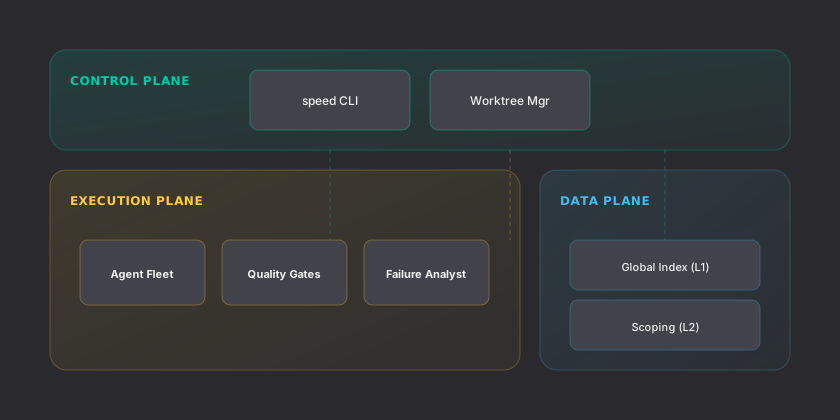
%%{init: { 'theme': 'base', 'themeVariables': { 'primaryColor': '#363638', 'primaryTextColor': '#f0f0f0', 'primaryBorderColor': '#00ccaa', 'lineColor': '#44bbee', 'edgeLabelBackground':'#2a2a2e', 'tertiaryColor': '#42424a' }}}%%
graph LR
    subgraph "Control Plane (CLI)"
        CLI["speed script"] --> WT["Worktree Manager"]
        CLI --> SM["State Manager (.speed/)"]
    end

    subgraph "Execution Plane (Resilience Fleet)"
        WT --> AG["Agent Fleet"]
        AG --> QG["Quality Gates"]
        QG --> FA["Failure Analyst"]
    end

    subgraph "Data Plane (Context Pipeline)"
        DP["Indexer & CSG"] -.-> AG
        DP -.-> QG
    end

    FA --> |"Success"| SM
    FA --> |"Retry"| AG
    SM --> |"Final Integration"| CLI
1. Control Plane (The Orchestrator)
Section titled “1. Control Plane (The Orchestrator)”The control plane is managed by the speed CLI and a set of core service scripts. It handles the lifecycle of a feature implementation, from initial planning to final git integration.
- Worktree Manager: Spawns isolated
git worktreeenvironments for every task. It symlinks heavy dependencies likenode_modulesor.venvfrom the project root to ensure near-zero setup time for agents. - State Manager: Maintains the
.speed/directory, tracking task statuses, agent PIDs, and the Codebase Semantic Graph (CSG).
2. Execution Plane (The Resilience Fleet)
Section titled “2. Execution Plane (The Resilience Fleet)”This plane contains the “brains” of the system:the autonomous agents and the quality gates that keep them grounded.
- Resilience Fleet: A collection of specialized agent roles (Architect, Plan Verifier, Developer, Reviewer, Coherence, and Debugger) that work together to implement a feature.
- Quality Gates: A tiered verification system. Grounding gates verify basic facts (file existence, non-empty diffs), while Quality gates run domain-specific tools like linters, type-checkers, and test suites.
- Failure Analyst: An intelligence layer that classifies failures. It can distinguish between a regression caused by the agent and a pre-existing failure in the codebase, preventing unnecessary retries.
- Provider System: A pluggable abstract layer that interfaces with LLM providers (Anthropic, OpenAI, or local hooks). It manages token pacing, rate-limit retries, and JSON extraction.
3. Data Plane (The Context Pipeline)
Section titled “3. Data Plane (The Context Pipeline)”The data plane provides the semantic context that powers the execution plane. It is structured into three layers that progressively narrow the codebase into a high-fidelity prompt. See the Context Pipeline for technical details.