The Context Pipeline
The data plane’s primary responsibility is the Context Pipeline. It transforms raw source code and specifications into high-fidelity markdown prompts optimized for specific agent roles.
For the conceptual overview (what each layer does, why), see The Context Pipeline. This page covers the implementation reference: artifacts, scoping process, assembly functions, and budget model.
Layer 1: Global Indexing (The World Model)
Section titled “Layer 1: Global Indexing (The World Model)”Layer 1 runs once per feature or on git head moves. It builds a persistent model of the codebase using the following artifacts:
| Artifact | Purpose |
|---|---|
| Project Map | Canonical file registry and metadata. |
| CSG | A semantic graph of symbols, references, and domain clusters. |
| Skeletons | Structural outlines (signatures only) of every file. |
| Spec Alignment | A mapping of product requirements to existing code artifacts. |
Layer 2: Per-Task Scoping
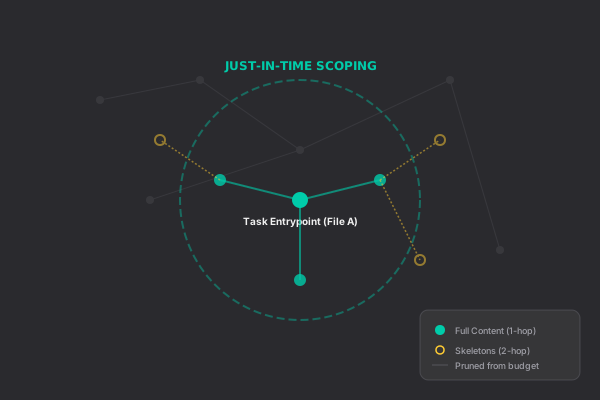
Section titled “Layer 2: Per-Task Scoping”Layer 2 runs per-task, just-in-time. It narrows the global Layer 1 index into a context package sized for one task’s context window. Outputs are written to .speed/features/{feature}/context/task-{id}/.
The 5-Step Scoping Process
Section titled “The 5-Step Scoping Process”- Symbol Resolution: Resolves all
files_touchedfrom the task definition to their corresponding symbols in the CSG. - Graph Walk: Breadth-first search on the reference graph. The delivery strategy depends on graph distance from the task’s touched files:
| Distance | Delivery | Rationale |
|---|---|---|
| 0 hops (files_touched) | Full content, never cut | The files the task will modify. Inviolable. |
| 1 hop | Full content (downgrade to skeleton if >2000 lines) | Direct callers/callees the agent needs to understand. |
| 2 hops | Skeleton only | Interface awareness without consuming the token budget. |
| 3+ hops | Dropped | Distant code unlikely to be relevant. |
- Decision Collection: Upstream decisions and architectural concerns from completed dependency tasks are injected into the task context.
- Spec Narrowing: Filters global spec-alignment claims down to the specific symbols relevant to the current task.
- Budget Balancing: Applies the token budget. The cut strategy preserves the most valuable context:
- Never cut
files_touched(distance 0). - Drop 2-hop files first.
- Downgrade large 1-hop files from full content to skeletons.
- Truncate the most distant skeletons as a last resort, leaving a pointer for the agent to use a “Read” tool if necessary.
- Never cut
Every cut is recorded in budget.json with the file path, original tier, downgraded tier, tokens saved, and reason. The failure classification system uses this data to detect context_cut failures.
Budget Dimensions
Section titled “Budget Dimensions”Each task’s budget is split across three dimensions plus a reserve:
| Dimension | Default | Contents |
|---|---|---|
code_context | 60% of total | Full source for touched files, skeletons for neighbors. |
task_context | 15% | Upstream decisions, dependency data, cross-cutting concerns. |
spec_context | 15% | Relevant requirements and alignment status. |
reserve | 10% | Headroom for agent tool outputs during execution. |
The total budget is per-stage (developer, reviewer, coherence, etc.) and configured in speed.toml.
Layer 3: Assembly Templates
Section titled “Layer 3: Assembly Templates”Layer 3 consists of stage-specific assembly functions. Each function accepts the Layer 2 artifacts and projects them into a markdown prompt.
Assembly Logic
Section titled “Assembly Logic”Every assembly follows the Context before Content principle:
- Identity: What this task is and why it exists.
- Constraints: Assumptions, cross-cutting concerns, and budget warnings.
- Material: The pre-loaded code, diffs, and analysis.
- Traceability: Spec references and current alignment status.
| Function | Primary Responsibility |
|---|---|
assemble_architect | Global mapping and decomposition. |
assemble_verifier | Validating the plan against requirements. |
assemble_developer | Implementing the task using scoped context. |
assemble_reviewer | Auditing the diff against criteria. |
assemble_coherence | Ensuring cross-task consistency. |
assemble_debugger | Root cause analysis with budget logs and context. |