Agent Orchestration
The Control and Execution planes handle the lifecycle of autonomous code implementation.
Control Plane: Worktree Management
Section titled “Control Plane: Worktree Management”SPEED avoids “dirtying” the main working directory by executing every task in an isolated git worktree.
Worktree Lifecycle
Section titled “Worktree Lifecycle”- Creation: For a given task, SPEED creates a new branch and matches it to a physical worktree path in
.speed/worktrees/. - Dependency Injection: To avoid slow
npm installorpip installcycles, SPEED symlinksnode_modulesor.venvfrom the project root into the worktree. - Execution: The developer agent runs its toolset entirely within this sandbox.
- Integration: Upon success, the branch is merged back to the feature branch and the worktree is pruned.
Execution Plane: The Resilience Fleet
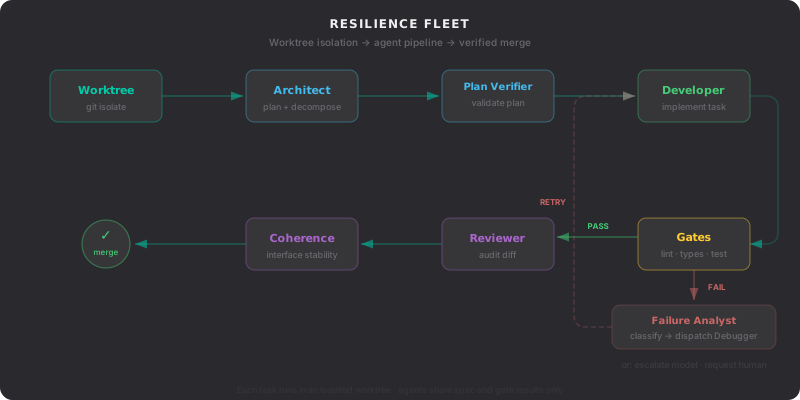
Section titled “Execution Plane: The Resilience Fleet”The “Resilience Fleet” is a set of deterministic agent roles combined with automated quality gates.
Specialization of Roles
Section titled “Specialization of Roles”| Role | Responsibility |
|---|---|
| Architect | High-level planning and dependency mapping. |
| Plan Verifier | Mathematical and logical validation of the Architect’s output. |
| Developer | Atomic implementation of a single task. |
| Reviewer | Auditing the Developer’s diff against the Technical Schemas and original product spec. |
| Debugger | Root cause analysis on failed tasks. Produces diagnosis and fix instruction for retries. |
| Coherence | Final check of interface stability across all tasks in a feature. |
For the full I/O specification of each role (what it receives, what it produces, which model tier), see the Agent Fleet reference.
Quality Gates
Section titled “Quality Gates”Quality gates are the primary grounding mechanism for agents.
| Gate | Type | Description |
|---|---|---|
| Syntax | Fact | Ensures code parses (AST validation). No LLM required. |
| Schema | Fact | Verifies changes against DB schemas or API contracts. |
| Lint/Types | Quality | Runs eslint, tsc, or mypy. |
| Tests | Quality | Runs the project’s test suite (Vitest, Pytest, etc.). |
| SAST | Security | Semgrep static analysis for code-level vulnerabilities. OWASP-mapped. |
| SCA | Security | Dependency scanning for known CVEs in third-party packages. |
| Secrets | Security | Pattern-based detection of leaked credentials and API keys. |
Scope Enforcement
Section titled “Scope Enforcement”Developer agents are scoped to the files declared by the Architect in files_touched. SPEED enforces this with graduated severity:
| Undeclared Files | Behavior |
|---|---|
| 1-2 | Warning logged. Agent continues. |
| 3+ | Classified as decomposition_error. Task fails. |
The SCOPE_STRICT environment variable overrides this behavior (strict = any undeclared file fails, disabled = no enforcement).
Failure Classification
Section titled “Failure Classification”When a task fails, the system classifies it into one of six subclasses using budget data, gate results, and agent output patterns. The classification drives recovery:
| Class | Subclass | Recovery |
|---|---|---|
| Pipeline | context_cut, exploration_death, decomposition_error, spec_gap | Fix the pipeline input (budget, spec, decomposition). |
| Complexity | exceeded_capacity, implementation_error | Retry with guidance, escalate model, or split the task. |
For the full classification system and recovery recipes, see Troubleshooting.